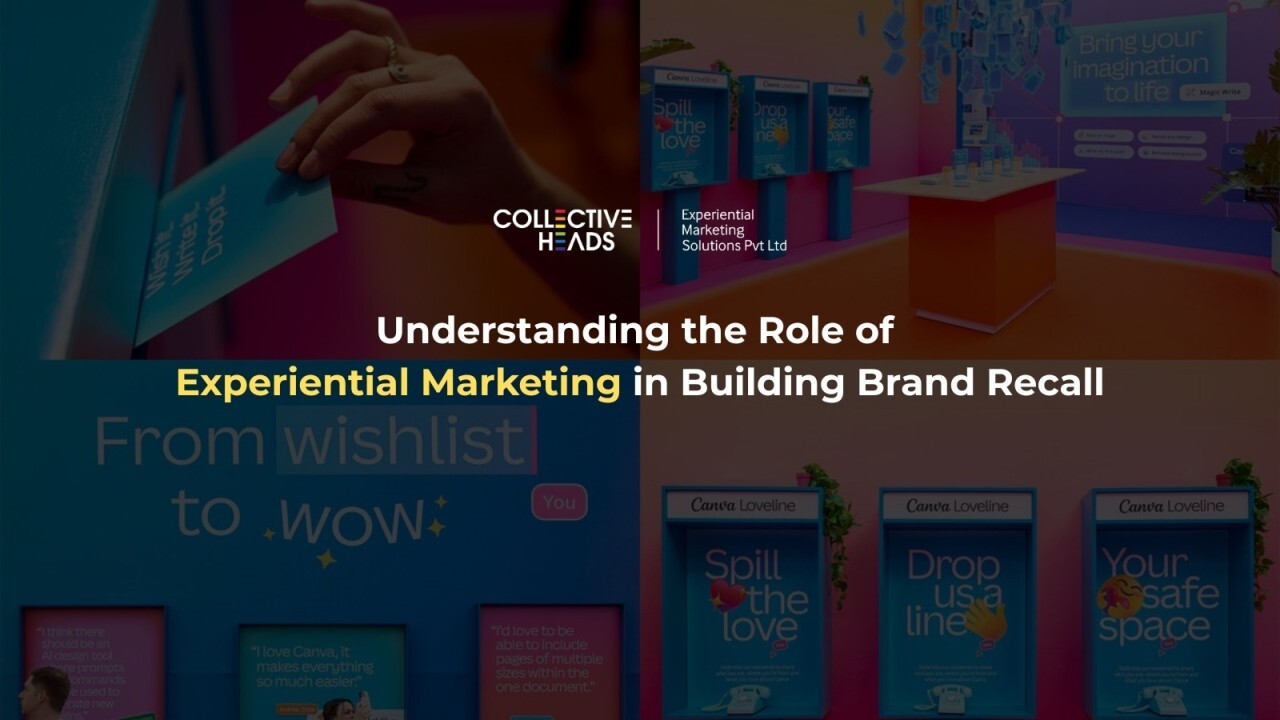
Understanding the Role of Experiential Marketing in Building Brand Recall
In today’s cluttered marketing landscape, where audiences are constantly bombarded with messages, capturing attention is no longer enough. The real challenge lies in being remembered. This is where experiential marketing steps in, not just as a tactic, but as a powerful strategy to build lasting brand recall.
Having completed 19 years in the industry, Collective Heads has seen firsthand how the shift from traditional communication to immersive brand experiences has redefined the way brands connect with their audiences. Today, it’s not about what you say, it’s about what people experience.
Moving Beyond Basics: Why Experiential Marketing Still Matters
For brands already investing in events and activations, the conversation is no longer about what experiential marketing is, but how effectively it is being leveraged to drive meaningful outcomes.
In a space where most brands are present, the real differentiator lies in how intentionally those experiences are designed. It’s about moving beyond standard booth setups or routine activations and creating environments that are strategically aligned with brand objectives and audience expectations.
Whether it’s an exhibition presence, a product launch, or a large-scale activation, the focus today is on crafting experiences that are not just engaging in the moment, but impactful enough to influence perception, recall, and long-term brand affinity.
Why Brand Recall Matters More Than Ever

Brand recall is the ability of consumers to remember your brand when they think of a product category. In competitive markets, this recall often becomes the deciding factor in purchase decisions.
Consumers may see hundreds of ads daily, but they remember:
- How a brand made them feel
- The experience they had with it
- The story they were part of
This emotional connection is what drives recall, and ultimately, loyalty.
The Experiential Advantage

1. Creating Emotional Connections
Experiences trigger emotions, and emotions drive memory. A well-executed brand experience can evoke excitement, curiosity, or even nostalgia, making the interaction far more memorable than a standard advertisement.
2. Multi-Sensory Engagement
Experiential marketing engages multiple senses, sight, sound, touch, and sometimes even taste and smell. This layered engagement strengthens memory retention and creates a deeper imprint of the brand.
3. Active Participation
When audiences actively engage with a brand, through interactions, games, installations, or live demonstrations, they become part of the story. Participation increases involvement, and involvement increases recall.
4. Storytelling in Action
Instead of simply communicating a message, experiential marketing allows brands to demonstrate their story. It turns abstract values into tangible experiences, making them easier to understand and remember.
5. Shareability and Amplification
Memorable experiences are inherently shareable. Attendees often document and share their experiences on social media, extending the reach of the activation and reinforcing brand recall among wider audiences.
From Presence to Impact
In events and exhibitions, brands often focus on visibility, how big the stall is, how many people visit. But visibility alone does not guarantee recall.
The shift needs to be from:
- Showing up → to standing out
- Informing → to immersing
- Engaging briefly → to creating lasting impressions
It’s not about how many people walk past your brand, but how many remember it afterward.
With 19 years of experience in the industry, our approach is rooted in insight, creativity, and precision execution. Every experience is designed with intent, from the first point of interaction to the final takeaway. We focus on crafting immersive environments, intuitive audience journeys, and memorable moments that translate into strong brand recall.
By combining creative storytelling, thoughtful design, and seamless execution, Collective Heads ensures that brands don’t just participate in events, they create impact that lasts well beyond the event itself.
Key Elements of High-Recall Experiences
To build strong brand recall through experiential marketing, certain elements are essential:
- A clear core idea: The experience should be rooted in a strong, simple concept
- Seamless design and execution: Every touchpoint should feel intentional
- Interactive touchpoints: Encourage participation, not just observation
- Consistency with brand identity: The experience should reflect the brand’s personality and values
- Memorable moments: Create one or two standout elements that people will talk about
The Long-Term Value
Experiential marketing may require more planning and investment than traditional methods, but its impact is significantly deeper and longer-lasting.
It builds:
- Stronger emotional connections
- Higher brand recall
- Increased word-of-mouth
- More meaningful engagement
In a world where attention is fleeting, experiences endure.
Experiential marketing is not just about creating events, it’s about creating moments that stay with people long after the interaction is over. When done right, it transforms brands from something people see into something they remember.
At Collective Heads, this belief has been at the core of our journey for 19 years, because brand recall isn’t created by chance, it’s designed with purpose.
Because at the end of the day, people may forget what you said or showed them, but they will always remember how you made them feel.
And that is where true brand recall begins.